
Dark Aesthetic Color by Number
Joyarc Coloring GamesBoard
4.7349.00 Reviews
- Version
- 1.2.0
- Installs
- 100.00K
- Age Rating
- Everyone
Screenshots







Our Review of Dark Aesthetic Color by Number
 Analysis by Appyee
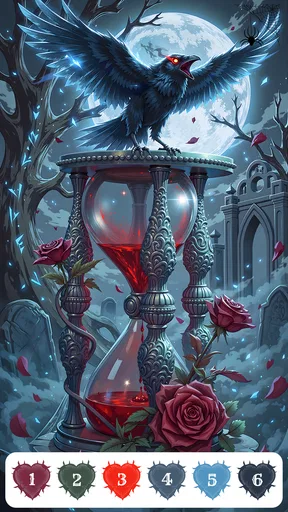
I approached Dark Aesthetic Color by Number as a quiet board-style coloring game rather than a traditional puzzle with timers, competition, or complicated rules. Its appeal is immediately clear: the artwork focuses on dark objects, symbols, and ornaments, while the color-by-number format gives the experience a simple structure. I can choose a picture, match the numbered areas with their colors, and gradually turn a mostly monochrome design into a finished gothic-style illustration.
That combination makes it an easy game to pick up when I want something calm and visually distinctive. It is free to start, suitable for Everyone, and runs on Android devices using version 7.0 or later. Joyarc Coloring Games is the developer, and the game has built a 4.8 average from around 1.8 thousand ratings, with more than 100 thousand installs. Those figures suggest that the concept has found a receptive audience, although the experience is still quite focused: this is a coloring pastime, not a broad collection of board-game mechanics.
How the game feels during ordinary use
In ordinary use, I find the appeal lies in how little preparation each session needs: I can open a design, pick up where my attention allows, and leave the rest for later. The useful distinction is between a quick pause and a longer coloring stretch, since detailed areas ask for more focus than the relaxed mood first suggests. That rhythm leads naturally to what makes a completed picture feel satisfying.
A gentle start with very little learning overhead
The strongest part of the design is how quickly I can understand what to do. There is no long ruleset to study and no strategic system to master before the first satisfying result appears. The numbered sections provide enough direction to keep the activity accessible, while the gothic palette gives the familiar format a more specific identity than ordinary coloring apps.
I find that useful after a busy day. If I have only a few minutes, I do not need to remember a previous strategy or rebuild a complicated game state. I can open a drawing, work through several areas, and stop when I feel finished for the moment. That low commitment is also why the game works well for people who enjoy coloring but do not want to manage physical pencils, paper, or a large collection of supplies.
The dark visual theme is not just a small decoration around a standard coloring book. It changes the mood of the activity. Symbols, ornaments, and shadow-heavy objects create a more mysterious atmosphere, so the game should appeal especially to players who find bright, cheerful coloring pages repetitive. I would not recommend it to someone looking for realistic painting tools or a wide range of art styles, because the central attraction is this particular dark aesthetic.
Perceived speed and the value of a simple interaction
In my experience, the basic coloring flow feels light because each action is straightforward. I am not constantly switching between complex menus or trying to coordinate several systems at once. That simplicity helps the game feel responsive during short sessions, even when my attention is divided between the screen and something else.
There is an important distinction here: a simple interface can make a game feel fast without turning it into an energetic game. The pace is intentionally unhurried. The satisfaction comes from filling small sections and watching the illustration develop, not from racing toward a score. Anyone expecting quick reflex challenges may interpret that calm rhythm as slow, but for relaxation it is one of the better qualities of the format.
A practical tip is to treat each picture as a series of small visual tasks instead of trying to finish everything in one sitting. I get more enjoyment from completing a cluster of related areas, pausing, and returning later than from forcing myself through the smallest remaining spaces. This approach also makes the game a better fit for commutes, waiting rooms, or a short break when I want an activity with a clear stopping point.
What happens during heavier use
The game is most demanding from a user’s perspective when a drawing contains many tiny numbered sections. The challenge is not strategic complexity; it is maintaining attention and tapping accurately across detailed artwork. On a larger screen, those moments are easier to manage. On a compact phone, I may need more patience when several neighboring areas look similar or when the remaining uncolored spaces are small.
This is where the dark theme can work both for and against the player. It gives the finished pictures a strong atmosphere, but darker artwork may require closer attention than a page with large, brightly separated blocks. I recommend increasing the screen brightness only as much as is comfortable and taking brief pauses during detailed images. That is less about device performance and more about avoiding eye strain and accidental taps.
Longer sessions can also expose the limits of this type of game. The first few completed designs feel rewarding because the transformation is visible. After several similar pages, the interaction may begin to feel repetitive, especially for players who need constant novelty. I see this as the main heavy-use limitation: the game is easy to continue, but not necessarily designed to provide deep variation from one coloring task to the next.
Stability, interruptions, and recovery
For a coloring game, reliability matters because the activity is often used casually. I want to be able to stop when a call arrives, switch to another task, and return without feeling that the whole session has become complicated. The game’s uncomplicated structure works in its favor here. There are fewer moving parts to keep track of than in a multiplayer board game, a strategy title, or a puzzle with several linked modes.
I still suggest using a natural stopping point when possible, particularly before closing the app or moving between demanding tasks on an older phone. That is a sensible habit for any progress-based game, and it is especially useful when a picture has taken time to complete. I would not describe this as a flaw unique to the title; it is simply a good way to protect the continuity of a relaxing activity.
The current version is 1.1.8, and that gives prospective players a clear version reference when checking compatibility or deciding whether their installation is current. I also like that the minimum operating-system requirement is relatively broad, covering Android 7.0 and later. That makes the game accessible to people who are not using a recent flagship phone, although the experience can still vary with screen size, available memory, and the general condition of an older device.
Resource expectations and device fit
I would place this game in the lighter end of the mobile entertainment category because its core activity is static visual coloring rather than real-time 3D action or online competition. That does not mean every phone will behave identically. Older hardware may take longer to open images or respond comfortably when the screen is crowded with small details, while a newer device should feel more at ease with the same kind of interaction.
For people using an older Android phone, the most important practical consideration is not raw gaming power but screen usability. A small display can make detailed ornaments tiring to color, and a worn touchscreen can make precision more frustrating. A tablet or larger phone may therefore improve the experience more than a faster processor would. This is one of the less obvious trade-offs: the game’s modest concept does not remove the need for a comfortable canvas.
Battery expectations should also be realistic. A calm coloring session is unlikely to feel like the same kind of workload as a demanding action game, but extended screen-on time still uses power. If I were planning to color for a long period away from a charger, I would lower brightness to a comfortable level and avoid running unnecessary apps in the background. Those habits support a smoother session without pretending that the game has been tested under every device condition.
Free access and the role of purchases
The game is free to download, which makes it easy to try the visual style before deciding whether it belongs in my regular rotation. There are in-app purchases ranging from $0.99 to $39.99 per item. That range is worth considering carefully because a free entry point does not automatically mean that every part of the experience will remain equally convenient without spending.
I would begin by playing at a normal, unhurried pace and deciding whether the available artwork already gives me enough variety. If I enjoy the coloring loop but feel tempted by optional purchases, I would set a personal limit before buying anything. The highest-priced item in the range is significant for a casual coloring game, so I would not treat purchases as an automatic extension of the basic experience.
This pricing structure also affects who should choose the game. Someone who wants an occasional free activity may be perfectly happy using it selectively. Someone who expects a large, unrestricted art library at no cost should examine the purchase prompts closely and compare the overall value with a traditional coloring app or a physical coloring book. The right choice depends less on the first download and more on how often the player expects to keep coloring.
Where it fits among usual alternatives
Compared with a conventional board game on mobile, this title is far more solitary and meditative. There is no need to wait for opponents, learn a strategy, or plan several turns ahead. That makes it a poor substitute for chess, checkers, digital card games, or competitive board apps, but a good alternative when I want the visual satisfaction of completing something without pressure.
Compared with general color-by-number apps, its advantage is its clear gothic direction. Many coloring games rely on cheerful animals, landscapes, food, or broad collections of unrelated subjects. Here, the darker objects and ornaments create a more consistent mood. The trade-off is obvious: a focused identity can feel more memorable to the right player and more restrictive to everyone else.
Compared with a freeform drawing application, it offers less creative control but more structure. I do not need to choose every color or decide how to compose an image from nothing. That is helpful when I want guidance, but limiting when I want to experiment with my own palette, brush behavior, or artistic technique. For learning illustration, I would choose a drawing tool. For completing atmospheric designs with minimal effort, this game is the better fit.
Three useful ways to get more from it
My first practical suggestion is to use it as a transition activity rather than background entertainment. A short coloring session between work and sleep can provide a clear mental change because the task has a beginning, visible progress, and a natural finish. I would avoid treating it as an endless feed; choosing one design and stopping after a meaningful section keeps the relaxing quality intact.
Second, use the artwork’s detail level to match your available attention. When I am tired or distracted, a design with larger areas is more comfortable than an ornament filled with tiny sections. When I want something that occupies my hands during a quiet period, a more intricate picture can be worthwhile. This simple matching process prevents the game from feeling either too dull or unnecessarily demanding.
Third, judge purchases by repeat use, not by the excitement of a single attractive design. If I return several times and still enjoy the dark visual language, a small purchase may feel more reasonable than buying immediately. If the basic coloring loop already feels repetitive after a few sessions, paying for more pages is unlikely to solve the underlying issue. The game’s strength is its mood and accessibility, not unlimited mechanical variety.
Who will enjoy it, and who should skip it
I would recommend it to players who like gothic imagery, quiet mobile activities, and clear visual progress. It is also suitable for casual users who want something that can be understood immediately and played in short bursts. The Everyone age rating makes it broadly approachable, although individual taste still matters: the dark aesthetic may be appealing to one person and gloomy to another.
I would skip it if my main goal were competitive board gaming, deep puzzles, social play, or serious digital art. I would also hesitate if I knew I would become frustrated by repeated tapping on small areas or by a focused collection of similarly themed images. A general coloring app may be better for someone who wants many unrelated subjects, while a drawing app is the stronger choice for someone who wants complete control over the final image.
My performance verdict
After considering the way it handles short sessions, detailed artwork, older Android compatibility, and longer periods of use, I see this as a deliberately modest game with a well-defined purpose. Its perceived speed comes from uncomplicated interaction rather than high-energy gameplay. Its resource demands should be more approachable than those of visually intensive games, but screen size and touch accuracy can matter when designs become intricate.
The most convincing reason to install it is not the free label alone. It is the combination of a distinctive dark visual identity and a low-pressure activity that asks very little from the player. The main limitations are equally clear: the coloring loop can become repetitive, detailed pictures may be tiring on small screens, and the in-app purchase range deserves restraint.
My final view is positive for the right audience. I would keep Dark Aesthetic Color by Number available for quiet breaks, especially when I want a structured activity without competition or complicated rules. It is not a replacement for a full board-game collection or an art studio, but as a focused gothic coloring game, it delivers a calm and accessible experience. Choose it for the atmosphere and the easy rhythm, not for deep gameplay or endless variety.
Privacy and Permissions
See what permissions an app requests and how it handles your data.
- Identity
- find accounts on the device
- Contacts
- find accounts on the device
- Photos/Media/Files
- read the contents of your USB storage, modify or delete the contents of your USB storage
- Storage
- read the contents of your USB storage, modify or delete the contents of your USB storage
- Wi-Fi connection information
- view Wi-Fi connections
- Other
- view network connections, full network access, run at startup, set wallpaper, control vibration, prevent device from sleeping, Google Play license check, read Google service configuration
Verdict
Strengths of Dark Aesthetic Color by Number
- Relaxing coloring sessions suitable for short breaks.
- Dark-themed artwork creates a distinctive visual style.
- Simple tap-to-color controls are easy for beginners.
- Large variety of moody designs to explore.
- Completed images can be saved and shared with friends.
Limitations of Dark Aesthetic Color by Number
- Some detailed pictures require considerable time to finish.
- Hints or extra tools may be limited without watching ads.
- The dark palette may feel repetitive for some users.
- Small numbered areas can be difficult to select on phones.
- Offline access may not cover every available coloring page.
Other Releases by Joyarc Coloring Games
View All
Cabin & House Paint by Numbers
Board4.6

Magical Forest Color by Number
Board4.7
Similar Picks in This Category
View All
Ludo King®
Gametion4.1

Ludo
Yarsa Games4.6

Tile Master® - Matching Game
Higgs Studio3.6

Checkers Online
CC Games4.6

Dominoes
Loop Games4.7

Chess
Chess Prince4.6
Frequently Asked Questions
What is Dark Aesthetic Color by Number?
Dark Aesthetic Color by Number is a relaxing digital coloring app built around moody, gothic, mysterious, and visually dramatic artwork. Instead of choosing colors freely, you fill numbered sections with the matching shades to complete each illustration. The app is designed for casual entertainment and stress relief, offering a simple experience for users who enjoy dark-themed art, fantasy imagery, and satisfying coloring progress.
How does the coloring system work?
Each picture is divided into numbered areas, and every number corresponds to a specific color in the palette. You select a color and tap the matching sections until they are completed. If an area is difficult to find, coloring apps of this type commonly provide hints or assistance tools, although availability can depend on the current version. The controls are generally straightforward for beginners.
Does Dark Aesthetic Color by Number work offline?
Some previously loaded coloring pages may remain available without an internet connection, but the full offline experience can vary according to the app version and device. New images, advertisements, optional content, and certain online features may require connectivity. If offline access is important to you, open several designs while connected and test the app in airplane mode before relying on it during travel.
Is Dark Aesthetic Color by Number free to download and use?
The app can generally be downloaded without an upfront purchase, but free access may include advertisements, optional purchases, or limitations on selected artwork and tools. Before starting, review the store listing and in-app purchase information carefully, particularly if children use the device. The free version is suitable for trying the coloring experience, while paid options may reduce interruptions or unlock additional content.
Is Dark Aesthetic Color by Number suitable for children?
The coloring mechanics are easy enough for many children, but the dark aesthetic may include gothic, eerie, fantasy, or emotionally intense imagery that is not appropriate for every age group. Parents should check the screenshots, content rating, advertisements, and purchase settings before allowing access. Younger users may also need supervision because some features can involve online connectivity or optional transactions.
Play our best games!


